
Lessons Learned: Implementing Data Governance for Ethical AI Training in High-Risk Domains
Practical lessons from a real-world data governance initiative in education that successfully fed an ethical AI system while meeting EU AI Act and GDPR requirements. Essential reading for AI governance and compliance leaders.
Organizations deploying AI in high-risk sectors — particularly those involving education, employment, or fundamental rights — quickly discover that technical model performance is only as good as the underlying data governance.
The following lessons, drawn from a structured implementation in an EdTech environment, highlight what actually works when transforming raw data into reliable, ethical fuel for AI systems under the EU AI Act.
1. Treat Data Governance as a Cyclical, Not Linear, Process
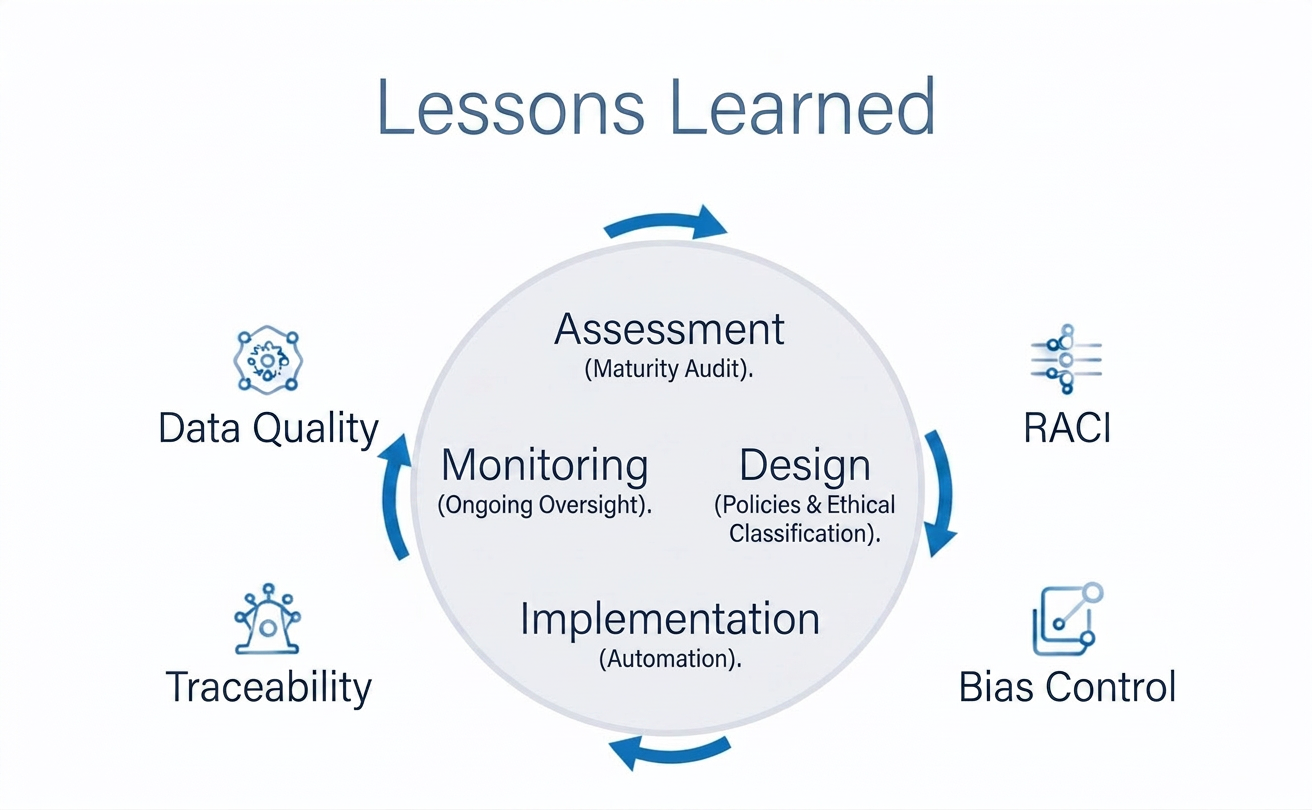
A one-off audit is insufficient. The most effective governance follows a repeating cycle of Assessment → Design → Implementation → Monitoring. This iterative approach allows continuous improvement of data quality and risk controls as the AI system evolves, directly supporting the EU AI Act’s requirement for ongoing risk management (Article 9).
2. Embed Ethical Classification and Policies from the Outset
Classifying data by sensitivity (high/medium/low) and defining ethical policies early prevents downstream bias amplification and privacy issues. Prioritizing “qualified” data — traceable, sufficiently complete, accurate, and anonymized — is essential for compliance with Article 10 of the EU AI Act and GDPR. Ethical governance is not an afterthought; it must be foundational.
3. Clarity of Roles and Accountability Is Non-Negotiable
Ambiguity in responsibilities leads to governance gaps. A formal RACI matrix that clearly assigns accountability to the CDO, data owners, stewards, custodians, and compliance functions proved critical. This structure ensures that data quality, ethical classification, and risk oversight are operational responsibilities rather than theoretical aspirations.
4. Define and Enforce Concrete Data Quality KPIs
Success depends on measurable standards. Organizations should track i.e:
- Completeness ≥ 95%
- Accuracy ≥ 98%
- Bias Delta < 5% across protected groups
- Ethical Compliance Rate 100%
These metrics, monitored through dashboards, provide early warning signals and objective evidence for conformity assessments and post-market monitoring.
5. Proactively Control the Five Core Risks
The most common risks in high-risk AI training are bias amplification, privacy breaches, low data quality, regulatory non-compliance, and scalability constraints. The experience showed that these can be effectively managed through:
- Stratified bias audits
- Systematic anonymization and DPIAs
- Strict quality gates before training
- Automated traceability and real-time alerts
- Scalable governance tooling
Addressing them early avoids costly rework later.
6. Invest in End-to-End Traceability and Real-Time Monitoring
Full data lineage — from original source (e.g., LMS or HR systems) through ethical classification and AI ingestion — is indispensable. Real-time dashboards and audit logs of classification decisions enable explainability, support mandatory technical documentation, and facilitate rapid response to drift or incidents.
7. Measure Both Technical and Human Outcomes
Effective governance ultimately delivers measurable business and societal value:
- Accelerated core processes (e.g., significantly shorter skill acquisition cycles)
- Higher engagement and outcome metrics (e.g., improved employability rates)
- Operational efficiency gains and sustainable scaling
- Enhanced fairness and personalization of AI-driven decisions
These outcomes demonstrate that strong data governance is not merely a compliance exercise — it is a strategic capability that improves both regulatory posture and real-world impact.
Final Reflection
The clearest lesson is that data governance for high-risk AI is most successful when treated as an integrated, organization-wide discipline rather than a technical side project. Organizations that invest early in cyclical processes, ethical policies, clear accountability, rigorous metrics, and full traceability are far better positioned to deploy trustworthy AI systems that meet both the letter and the spirit of the EU AI Act.
Leaders should ask:
- Are our data governance processes truly cyclical and monitored in real time?
- Do we have clear accountability and measurable quality thresholds?
- Are we systematically mitigating the core risks before data reaches AI training pipelines?
Applying these lessons can transform data governance from a regulatory obligation into a genuine competitive advantage in the age of responsible AI.

