
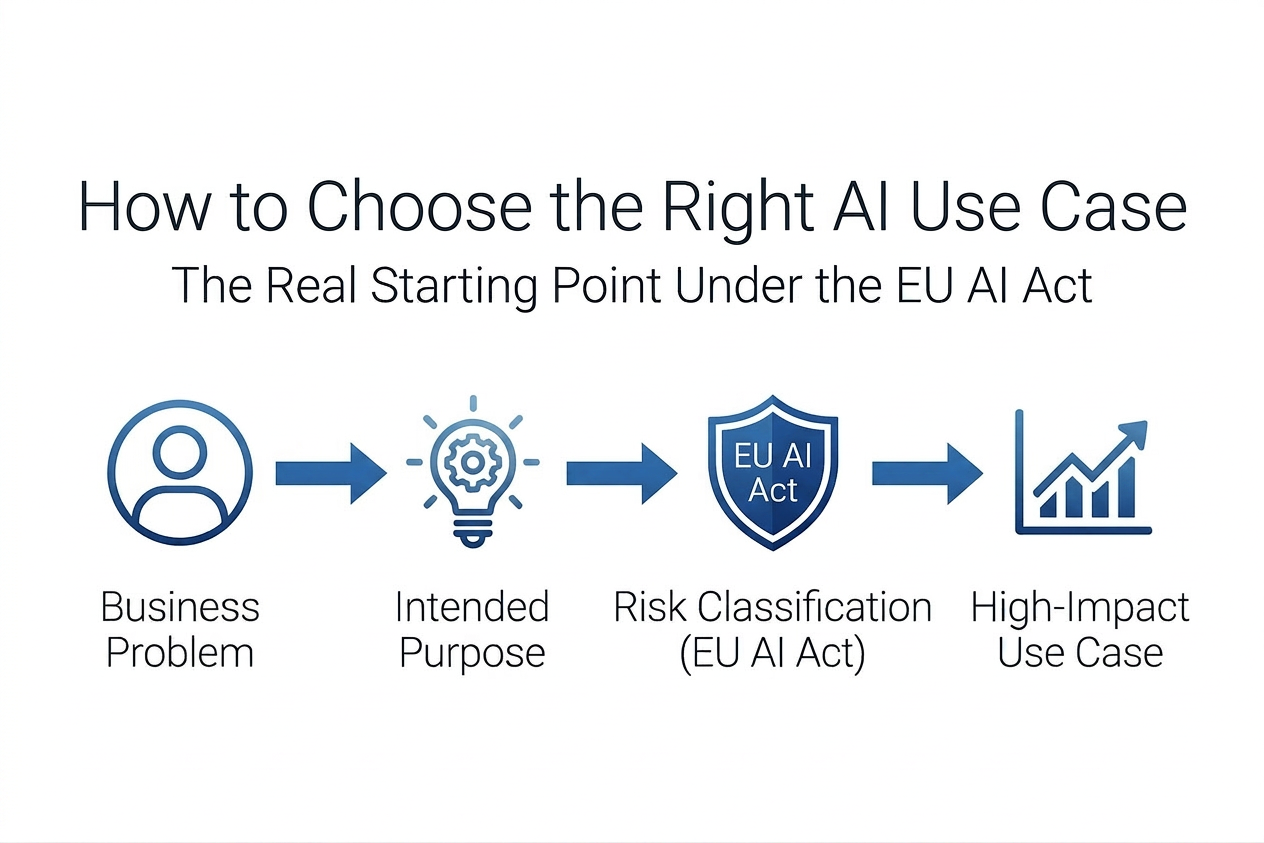
Most companies are launching AI projects for the wrong reasons. Here’s a practical framework to identify high-impact, compliant, and valuable use cases before you waste time and money.
The EU AI Act is clear: risk classification depends entirely on the intended purpose and the context in which the AI system will be used (Article 3 and Annex III).
Yet the majority of organizations still start their AI journey backwards.
They hear about generative AI, see competitors experimenting, and jump straight into building something — without first asking the most important question:
“What real business problem are we actually trying to solve?”
This is exactly why so many AI initiatives end up in the “pilot purgatory” or get quietly shut down after six months.
The Cost of Getting the Use Case Wrong
When companies choose the wrong use case, they face:
- Wasted budget on low-value experiments
- Regulatory surprises (unexpected high-risk classification)
- Internal resistance and loss of trust
- Zero measurable business impact
One of our clients started in a “Stagnating / Ad-hoc” maturity level. They had several scattered AI experiments but no clear direction. Only when they stopped and identified a specific, high-impact use case — real-time predictive monitoring for operational risk — did they finally move forward with clarity, compliance, and real ROI.
A Practical Framework to Identify the Right Use Case
Here’s a simple 5-step process you can use today (aligned with the MindForge AI Risk Management Handbook and the EU AI Act):
Start with the Business Problem, Not the Technology
1- Ask: What is the single most painful or expensive problem in our operations right now?
2- Define the Intended Purpose Clearly
3- Write it in one sentence: “This AI system will [action] to achieve [outcome] for [user/group].”
4- Map the Context and Risk Level Who will use it?
- What decisions will it influence?
- Does it fall into any high-risk categories (employment, credit, law enforcement, etc.)?
5- Evaluate Strategic Value vs. Risk
- Use a simple matrix: High Value / Low Risk → Green light.
- High Risk / Low Value → Stop or redesign.
6- Document Everything
- Create a one-page use case card that includes purpose, context, risk classification, and required human oversight.
Reflection Questions for Your Leadership Team
- Are we implementing AI because it solves a strategic problem, or simply because “we need to have AI”?
- Do we have at least one use case that is clearly documented and classified according to the EU AI Act risk levels?
- What is the biggest obstacle preventing us from identifying high-impact use cases right now?
Final Thought
The EU AI Act doesn’t just require compliance — it forces organizations to become more intentional about AI.The companies that will win in the next 2–3 years are not the ones with the most models.
They are the ones that started with the right use case.
Ready to move from reactive experimentation to strategic AI adoption?
The first step is building shared AI Literacy across your organization (Article 4 of the AI Act). Once everyone speaks the same language, identifying the right use cases becomes dramatically easier.

