
The EU AI Act is no longer coming — it’s here. For high-risk AI systems (education, employment, credit, etc.), Article 10 makes one thing crystal clear: the quality, governance, and ethical handling of training data are not optional. They are mandatory.
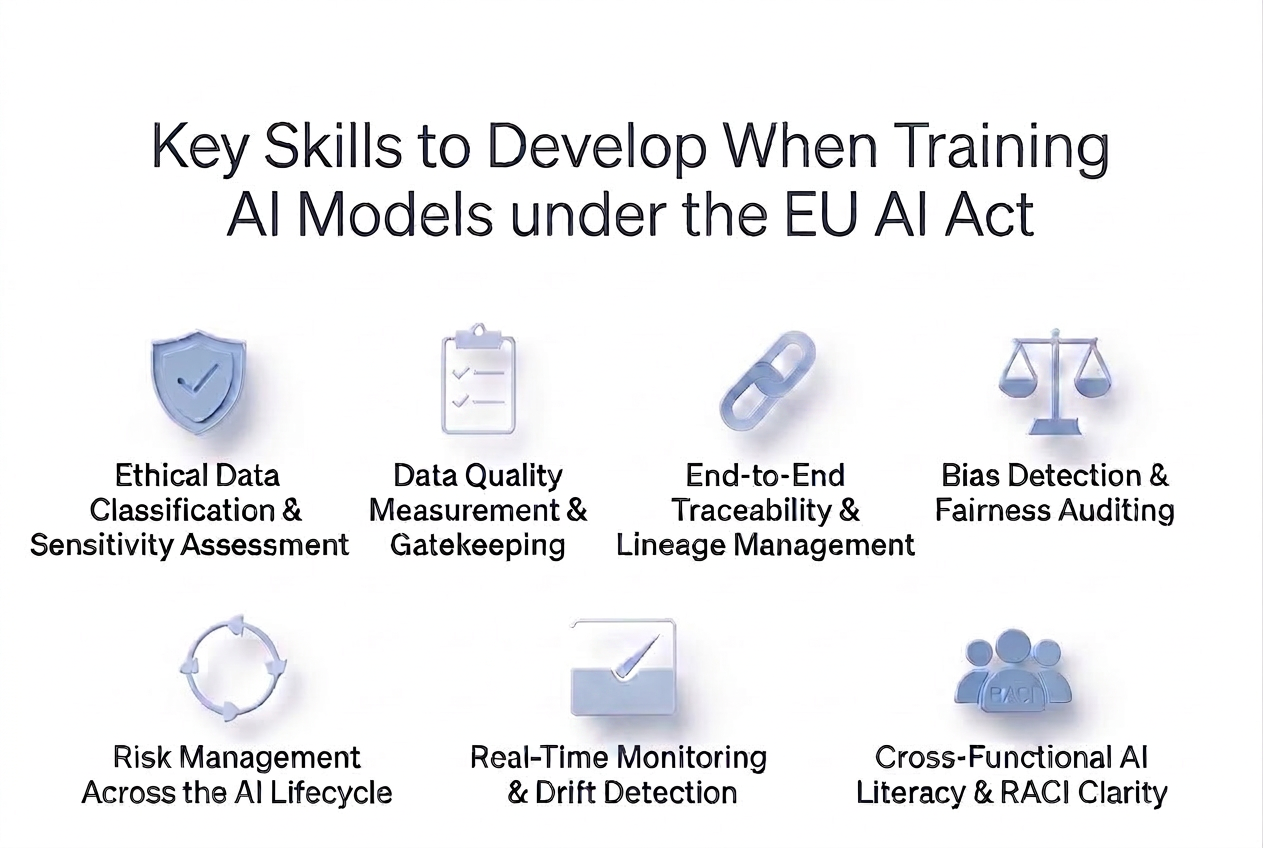
From real-world data governance implementations in sensitive domains, here are the 7 essential skills teams must build today to train compliant, trustworthy AI models:
1- Ethical Data Classification & Sensitivity Assessment
Ability to classify data as high/medium/low sensitivity and apply purpose limitation and consent rules — foundational for Article 10 compliance.
2- Data Quality Measurement & Gatekeeping
Master KPIs such as completeness (≥95%), accuracy (≥98%), and bias delta (<5%) to ensure only “qualified” data enters training pipelines.
3- End-to-End Traceability & Lineage Management
Track every dataset from source to model output, including ethical classification and transformations — a core requirement for technical documentation and audits.
4- Bias Detection & Fairness Auditing
Run stratified audits and continuous monitoring to prevent bias amplification in high-risk use cases (directly supports Article 9 risk management).
5- Risk Management Across the AI Lifecycle
Identify, document, and mitigate risks at every stage — Assessment, Design, Implementation, and Monitoring — using a cyclical governance approach.
6- Real-Time Monitoring & Drift Detection
Set up dashboards and alerts for data quality degradation, behavioural drift, and compliance breaches post-deployment.
7- Cross-Functional AI Literacy & RACI Clarity
Ensure technical and non-technical teams share a common language and clear accountability (RACI) — fulfilling Article 4 obligations and closing the internal trust gap.
Bottom line:
Training effective AI models under the EU AI Act is no longer just a machine-learning challenge — it is a governance, ethics, and data-quality challenge. Organizations that deliberately develop these skills move from reactive compliance to proactive, responsible AI deployment.

