
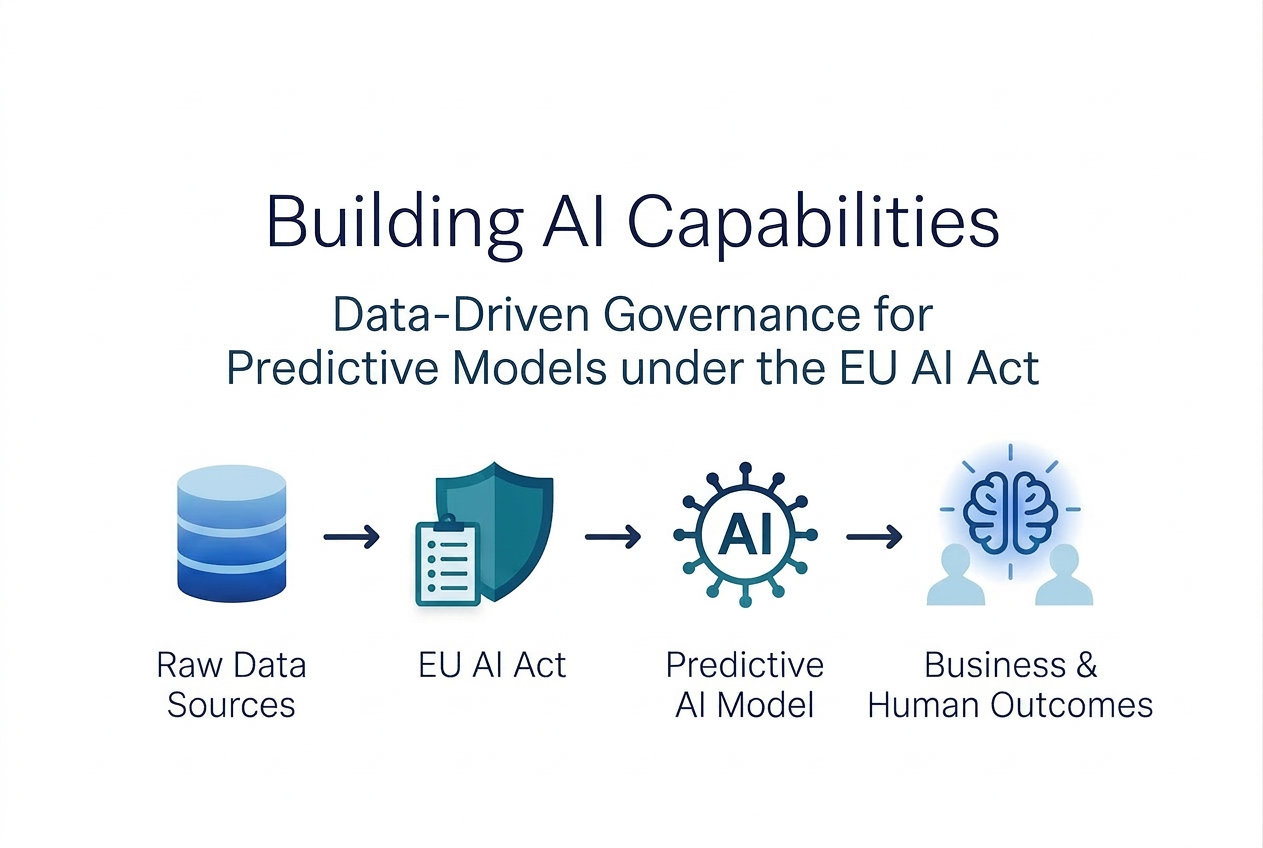
Practical guidance on the essential capabilities organizations must develop to implement data-driven, predictive AI systems responsibly. Focuses on governance, data quality, risk management, and capability building aligned with the EU AI Act.
The EU AI Act has shifted the conversation from “Can we build AI?” to “Are we capable of building AI responsibly?” Article 4 requires organizations to ensure sufficient AI literacy across the workforce, but true capability building goes far beyond basic awareness.
It demands structured development of data-driven practices, predictive analytics capabilities, and robust governance — especially when deploying high-risk AI systems that influence education, employment, or fundamental rights.
Drawing from real-world implementations in data-intensive environments, here are the core capabilities organizations must cultivate to succeed with predictive AI while meeting regulatory expectations.
1. Capability to Identify and Prioritize the Right Use Case
The foundation of any successful AI initiative is selecting the correct use case. Many organizations launch predictive models reactively, without clearly defining the business or societal problem they solve. Key capabilities to develop:
- Ability to articulate the intended purpose in one clear sentence (required under the EU AI Act).
- Structured evaluation of strategic value versus risk level (high-risk Annex III categories).
- Use-case documentation and classification process that integrates business objectives with regulatory triggers.
Lesson from practice: Predictive models deliver the greatest impact when they address specific, measurable outcomes — such as accelerating processes or personalizing recommendations — rather than experimenting with technology for its own sake.
2. Data Governance as the Core Capability for Predictive AI
Predictive models are only as reliable as the data that trains them. Building strong data governance is the single most important capability for ethical, high-performing AI.
Essential elements to develop:
- Cyclical governance process: Assessment of data maturity → Design of ethical policies and glossaries → Implementation with automation → Continuous monitoring.
- Ethical classification: Systematic labelling of data by sensitivity (high/medium/low) to support GDPR and Article 10 of the EU AI Act.
- Data quality standards: Enforce minimum thresholds — completeness ≥ 95%, accuracy ≥ 98%, bias delta < 5% — before data enters training pipelines.
Practical outcome: High-quality, traceable data creates a virtuous feedback loop that powers accurate predictive recommendations and continuous model improvement.
3. Cross-Functional Roles and Accountability
Capability building requires clear ownership. Organizations that succeed establish a formal RACI matrix covering:
- Chief Data Officer / AI Governance Lead → strategic accountability
- Data Owners → domain rules and quality
- Data Stewards → profiling, maintenance, and ethical classification
- Data Custodians → security and anonymization
- Compliance & Risk teams → regulatory alignment
This structure eliminates silos and ensures governance is embedded throughout the AI lifecycle.
4. Risk Management Across the AI Lifecycle
High-risk predictive AI demands proactive risk management at every stage (aligned with Mind Forge and EU AI Act Article 9):
- Assessment: Identify maturity gaps and bias patterns early.
- Design: Build fairness and privacy controls into policies.
- Implementation: Enforce quality gates and traceability.
- Monitoring: Detect data drift, behavioural changes, and compliance issues in real time.
Critical risks to master: Bias amplification, privacy breaches, low data quality, regulatory gaps, and scalability constraints.
5. Technical and Organizational Monitoring Capabilities
Predictive models evolve. Organizations must develop:
- End-to-end data lineage and traceability (mandatory for technical documentation).
- Real-time dashboards tracking data quality, bias, and ethical compliance.
- Automated alerts for quality degradation or substantial modifications.
These capabilities support post-market monitoring obligations and enable rapid, evidence-based model updates.
6. Measuring Success: Technical, Business, and Human Outcomes
Capability building is incomplete without clear metrics. Track:
- Process efficiency (e.g., cycle time reduction)
- Predictive accuracy and personalization effectiveness
- Fairness indicators (bias delta)
- Broader impact (engagement, outcome improvement, scalability)
Strong governance consistently unlocks measurable gains in both performance and regulatory confidence.
Final Advice for Leaders
Building AI capabilities is not about adopting the latest model — it is about developing the organizational muscle for responsible, data-driven prediction. Organizations that systematically invest in use-case clarity, ethical data governance, defined roles, lifecycle risk management, and continuous monitoring are the ones that will deploy predictive
AI that is not only compliant with the EU AI Act but genuinely valuable to users and society.
Self-assessment questions for your organization:
- Do we have a repeatable process for identifying high-impact predictive use cases?
- Is data governance cyclical, measured, and ethically governed?
- Are roles, risks, and monitoring mechanisms clearly defined and operational?
The EU AI Act is raising the bar. The organizations that treat it as a catalyst for genuine capability building — rather than a compliance burden — will lead the next wave of trustworthy, predictive AI.

